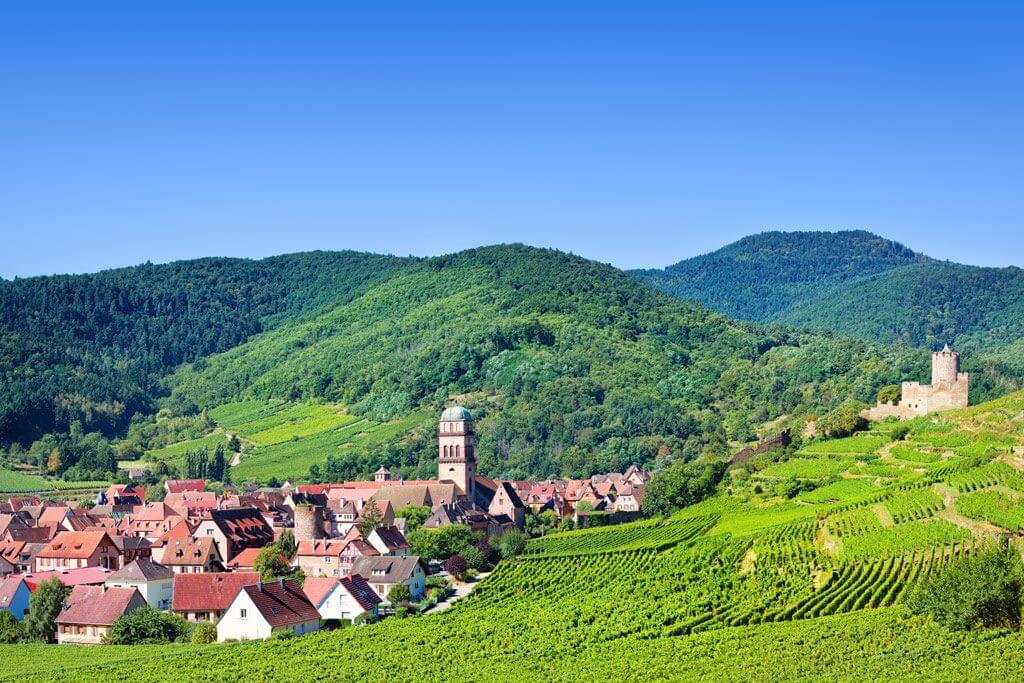
Alsace arrives through details. Villages that look almost too neat to be real, steep vineyard slopes that catch the eye immediately, and wines that do not sit comfortably inside the usual French categories. It feels self-contained in the best way. The food, the dialect, the vineyard culture, all of it feels specific to this narrow strip of land.
On this trip I visited three houses we already work with. Seeing them again made the region click even harder. Each estate showed a different side of Alsace, and together they made a strong case for why I keep coming back here to taste and buy.
Domaine Weinbach, Kaysersberg
The Clos des Capucins sits just outside Kaysersberg, enclosed behind a wall that dates to 1612, when Capuchin friars first planted the site. Catherine Faller and her sons Théo and Eddy manage the estate now, continuing work that Colette Faller began after 1979 when she took over the domaine. The biodynamic conversion, complete across all 28 hectares by 2005, was not a philosophical gesture but a practical commitment to the health of land that already had centuries of careful attention behind it.
The Schlossberg is the wine to understand here. It is the largest grand cru holding of any single grower in Alsace, planted on granite, and it produces Rieslings of a particular kind of tension: precise, tightly wound in youth, opening slowly over years into something more expansive. There is nothing soft about these wines. They are not made to please quickly. They are made to age, to develop, to be exactly what they said they were going to be, but later.
What I keep coming back to at Weinbach is the control in the wines. Indigenous yeasts, no chaptalization, no malolactic conversion, no added enzymes. Nothing feels dressed up. The Fallers talk about guarding expression rather than building style, and tasting the range, that feels exactly right.
"Each terroir imprints its personality on the wines. We see ourselves as guardians of expression, not architects of style."Domaine Weinbach
Pierre Frick, Pfaffenheim
Pierre Frick sits at the other end of the stylistic register, though the commitment to quality is no less absolute. Jean-Pierre Frick began farming organically in 1970 and moved to full biodynamic practice in 1981, receiving Demeter certification in 1985 at a time when only two other French wine estates held that recognition. His son Thomas now works alongside him, and the sense of continuity in the cellar is palpable.
What sets Pierre Frick apart in Alsace is the no-sulfite approach. Most of the range has been made without added sulfites since the late 1990s, and you can feel that energy in the glass. These wines move, change, and ask for attention in a way heavily stabilised wines do not.
The Carrière parcel is particularly compelling: a plot above the Vorbourg grand cru on rare yellow sandstone, used for extended skin-contact Riesling. The result is unlike almost anything else in Alsace. The skin contact gives the wine a depth and texture that standard Alsatian Riesling never achieves, and the absence of added sulfites means the wine is genuinely dependent on the quality of the farming and the cellar work. There is no safety net.
Jean-Pierre's framing of the work is worth noting. In his words, the cellar is not a place of manufacture but a place of raising. The wines are grown, not made. That distinction, simple as it sounds, captures something real about the difference between these wines and almost everything else on the market.
Domaine Schoffit and Rangen de Thann
Rangen de Thann is the southernmost grand cru in Alsace, a near-vertical south-facing slope of volcanic rock above the town of Thann that was largely abandoned by the mid-twentieth century because working it had become economically untenable. Bernard Schoffit spent decades buying and reclaiming plots there, slowly assembling 6.5 hectares of the total grand cru area. That is approximately one-third of Rangen, making Schoffit the dominant landowner on a site that, in terms of sheer physical difficulty, has no equal in the region.
The volcanic character of Rangen comes through in the wines in a way that is difficult to articulate but impossible to miss. There is a mineral energy to the best Schoffit Rieslings and Gewürztraminers that feel different from anything produced on limestone or granite elsewhere in Alsace. The wines need time. They are not immediately expressive. But what they open into, with patience, is worth the wait.
Bernard's son Alexandre now leads the estate while Bernard remains active. The transition has been careful, and the quality of recent releases reflects that continuity. The domaine has been farming organically across all 18.8 hectares, with biodynamic conversion underway, a shift that reinforces what the wines have always been about: working with the land, not against it.
The wines are compelling in a rather quiet way. That phrase, borrowed from someone who knows the domaine well, could stand for much of what Alsace produces at its best. Not showy. Not seeking approval. Exactly themselves.
What the trip sharpened
Returning from Alsace, I found myself thinking less about individual wines and more about a shared characteristic: patience. All three houses are run by people who think in decades, not vintages. The investments they have made, in land, in certification, in farming practice, in building relationships with their soils, are not investments that pay off quickly.
That long view is visible in the wines themselves. They are not wines made for easy drinking or immediate approval. They ask something of the person opening them. They ask for the right moment, the right food, the right amount of attention.
These are the wines, and the growers, that remind me what this work is really about. Not building the biggest range. Not chasing volume. Just finding people doing something specific and worth backing, then making sure those bottles reach the drinkers who will get it.
De Elzas is een streek die zich ontvouwt in een reeks kleine verrassingen. De dorpen zijn onwaarschijnlijk pittoresk, de wijngaarden lopen steil op, en de wijnen vallen buiten de nette categorieën die de rest van Frankrijk zichzelf graag oplegt. De keuken is uitgesproken Elzassisch, net als de wijncultuur. Er heerst hier een bijzondere ernst, een geworteldheid die voortkomt uit precies weten waar je bent en bewust kiezen om daar te blijven.
Op deze reis bezocht ik drie huizen waarmee we al werken. Alle drie gaven mij een scherper beeld van waartoe de Elzas in staat is en waarom ik er steeds naar terugkeer om te proeven en te kopen.
Domaine Weinbach, Kaysersberg
De Clos des Capucins ligt net buiten Kaysersberg, omsloten door een muur die dateert uit 1612, toen Kapucijnse monniken het terrein voor het eerst beplanten. Catherine Faller en haar zonen Théo en Eddy beheren het domein nu, en zetten het werk voort dat Colette Faller begon nadat zij in 1979 het domein overnam. De biodynamische omschakeling, voltooid over alle 28 hectare in 2005, was geen filosofisch gebaar maar een praktische toewijding aan de gezondheid van land dat al eeuwen van zorgvuldige aandacht achter de rug had.
De Schlossberg is de wijn die je hier moet begrijpen. Het is de grootste grand cru-bezitting van één enkele teler in de Elzas, aangeplant op graniet, en hij levert Rieslings met een bijzondere vorm van spanning op: precies, strak in hun jeugd, en pas over jaren echt openbloeiend. Er is niets zachts aan deze wijnen. Ze zijn niet gemaakt om snel te behagen. Ze zijn gemaakt om te rijpen, zich te ontwikkelen en uiteindelijk precies te worden wat ze beloven.
Wat mij opvalt aan Weinbach is hoe consequent de wijnen een filosofie van terughoudendheid weerspiegelen. Inheemse gisten, geen chaptalisatie, geen malolactische omzetting, geen toegevoegde enzymen. De Fallers beschrijven zichzelf als bewakers van expressie in plaats van architecten van stijl. Als je het assortiment proeft, houdt die beschrijving stand.
"Elk terroir drukt zijn persoonlijkheid af op de wijnen. Wij zien onszelf als bewakers van expressie, niet als architecten van stijl."Domaine Weinbach
Pierre Frick, Pfaffenheim
Pierre Frick bevindt zich aan het andere einde van het stilistische spectrum, hoewel de toewijding aan kwaliteit niet minder groot is. Jean-Pierre Frick begon in 1970 biologisch te telen en stapte in 1981 volledig over op biodynamie. In 1985 kreeg hij Demeter-certificering, op een moment dat slechts twee andere Franse wijndomeinen die erkenning hadden. Zijn zoon Thomas werkt nu naast hem, en de continuïteit in de kelder is voelbaar.
Wat Pierre Frick binnen de Elzas onderscheidt, is de sulfietvrije aanpak. Het merendeel van de productie wordt sinds het einde van de jaren negentig gemaakt zonder toegevoegde sulfieten. Deze wijnen zijn op een manier die onverwacht kan zijn, werkelijk levend. Ze verschuiven in het glas, ontwikkelen zich tijdens een maaltijd en vragen aandacht op een manier die zwaar gestabiliseerde wijnen simpelweg niet doen.
Het perceel Carrière is bijzonder boeiend: een stuk land boven de Vorbourg grand cru op zeldzame gele zandsteen, gebruikt voor Riesling met verlengd schilcontact. Het resultaat is onvergelijkbaar met bijna alles elders in de Elzas. Dat schilcontact geeft de wijn een diepte en textuur die klassieke Elzasser Riesling zelden bereikt, en de afwezigheid van toegevoegde sulfieten betekent dat alles staat of valt met de kwaliteit van het werk in de wijngaard en in de kelder. Er is geen veiligheidsnet.
De manier waarop Jean-Pierre over zijn werk spreekt, is veelzeggend. In zijn woorden is de kelder geen productieplaats maar een plek waar wijn wordt grootgebracht. De wijnen worden geteeld, niet gemaakt. Dat onderscheid klinkt eenvoudig, maar het vangt wel degelijk iets wezenlijks van het verschil tussen deze flessen en bijna alles daarbuiten.
Domaine Schoffit en Rangen de Thann
Rangen de Thann is de zuidelijkste grand cru in de Elzas, een bijna verticale, naar het zuiden gerichte helling van vulkanisch gesteente boven de stad Thann die grotendeels werd verlaten in het midden van de twintigste eeuw omdat het bewerken ervan economisch onhoudbaar was geworden. Bernard Schoffit besteedde tientallen jaren aan het kopen en terugwinnen van percelen daar, waarbij hij langzaam 6,5 hectare van het totale grand cru-oppervlak samenstelde. Dat is ongeveer een derde van Rangen, waarmee Schoffit de dominante grondeigenaar is op een locatie die, qua pure fysieke moeilijkheid, geen weerga kent in de regio.
Het vulkanische karakter van Rangen komt door in de wijnen op een manier die moeilijk te verwoorden maar onmogelijk te missen is. Er zit een minerale energie in de beste Schoffit Rieslings en Gewürztraminers die anders aanvoelt dan alles wat elders in de Elzas op kalksteen of graniet wordt gemaakt. De wijnen hebben tijd nodig. Ze zijn niet meteen expressief. Maar wat zich met geduld opent, is de wachttijd waard.
Bernards zoon Alexandre leidt nu het domein terwijl Bernard actief blijft. De overgang is zorgvuldig verlopen, en de kwaliteit van recente releases weerspiegelt die continuïteit. Het domein werkt biologisch over alle 18,8 hectare, met een biodynamische omschakeling in gang, een stap die versterkt waar deze wijnen altijd al om draaiden: werken met het land, niet ertegenin.
De wijnen zijn overtuigend op een tamelijk stille manier. Die formulering, geleend van iemand die het domein goed kent, zou kunnen gelden voor veel van wat de Elzas op zijn best produceert. Niet opvallend. Niet op zoek naar goedkeuring. Precies zichzelf.
Wat de reis aanscherpte
Terug in Nederland dacht ik minder aan individuele wijnen en meer aan wat deze drie huizen delen: geduld. Ze worden gerund door mensen die in decennia denken, niet in jaargangen. Hun investeringen in land, certificering, teeltpraktijk en het opbouwen van relaties met hun bodems zijn geen beslissingen die snel renderen.
Die lange visie is zichtbaar in de wijnen zelf. Het zijn geen wijnen die zijn gemaakt voor gemakkelijk drinken of onmiddellijke goedkeuring. Ze vragen iets van de persoon die ze opent. Ze vragen het juiste moment, het juiste eten, de juiste hoeveelheid aandacht.
Dit zijn de soorten wijnen, en de soorten producenten, die verduidelijken waar dit werk over gaat. Niet catalogiseren. Niet volume. De mensen vinden die iets doen dat elders niet kan worden gerepliceerd, en zorgen dat die wijnen de mensen bereiken die ze zullen begrijpen.